Showing posts with label NAACP. Show all posts

Sunday, April 10, 2011

Misplaced Priorities: A new report from the NAACP

On April 7th, the NAACP released a new report, Misplaced Priorities, that examines America's escalating levels of prison spending and its impact on state budgets and our nation’s children.
Misplaced Priorities tracks the steady shift of state funds away from education and toward the criminal justice system. Researchers have found that over-incarceration most often impacts vulnerable and minority populations, and that it destabilizes communities.
The report is part of the NAACP’s “Smart and Safe Campaign,” and offers a set of recommendations that will help policymakers in all 50 states downsize prison populations and shift the savings to education budgets.

Read more...

Friday, April 1, 2011

Join us April 4th for the "We Are One... Standing in solidarity with Labor" rally

On April 4th, 1968, Dr. Martin Luther King Jr. was assassinated in Memphis Tennessee, where he had gone to stand with sanitation workers who were standing up and demanding fair treatment and the right to bargain collectively for a voice at work and a better life.

Today, that same demand is electrifying people across America. It's the demand of all people - Black, White, Latino,  and Asian American: The right to join together to fight for our common dreams.

On Monday, April 4th, Join the Wichita Branch and Kansas NAACP, the Wichita/Hutchison Labor Federation, and the Kansas Chapter of the National Organization for Women as we STAND IN SOLIDARITY WITH LABOR.

What: The "WE ARE ONE" Rally
When: April 4th at 7:00pm
Where: Interfaith Ministries  (829 N Market St)
The event is free and open to the public

Read more...

Monday, March 14, 2011

Let your Legislators Hear Your Voice by calling 352 BE HEARD

Have you ever wanted to sound off and let your legislators know exactly how you felt about an issue? Have you ever really wanted an opportunity to weigh in on an issue, but you were unable to make it to a specific hearing or forum?

352 BE HEARD is an initiative designed to afford you the opportunity to speak directly to your elected representatives and to have them hear your opinions in your own voice. Simply dial 352 BE HEARD (352-234-3274) from your phone and sound off on the issue of the day. Messages are then converted into MP3 format and complied on interactive documents which are then sent electronically to Legislators, elected officials and the press.

Selected messages may even be made available through the blog or other interactive media so that we can all hear the real voices of the General Public live and unfiltered.

As the Kansas Legislature prepares to cut more than 50 MILLION dollars from our schools, leading to furloughs and increased class sizes, as they debate rolling back human and civil rights protections that we all take for granted, as they consider a push to eliminate get-out the vote type registration drives and door-to-door canvassing through a vacuous Voter ID Bill, and as they prepare to vote on yet ANOTHER Tax Cut bill - this time to phase out ALL Corporate Income taxes over the next 5 years Despite the fact we are already facing a $550 million dollar Revenue shortfall, YOUR VOICE IS NEEDED NOW MORE THAN EVER.

Please call 352 BE HEARD - and let YOUR voice Be Heard!


352 BE HEARD (352-234-3274) is a service jointly provided by the Wichita Branch and Kansas State Conference of the NAACP.

Read more...

Sunday, March 13, 2011

Let's tell the Truth about Kansas' budget shortfall


Gov. Sam Brownback announced his plan to cut $50 million from public schools. His proposed cut to base state aid to education will reduce annual school spending per pupil by $22, from $4,012 to $3,990. In fact the Governor's proposed Education cuts total nearly 90% of the $56.5 million in overall reductions that have been announced thus far.

The legislators and even the press have chimed in stating that while these are difficult cuts, they are in fact necessary due to our current fiscal condition.

The only problem with this is that we all seem to act as though our current fiscal condition was magically imposed on us and that we are merely reacting to circumstance... When the Truth is, many of the very same Legislators who are now looking to take an ax to public schools, created or at least exacerbated our fiscal tsunami by going to Topeka and voting to reduce revenues year after year through irresponsible tax cuts.

Our Legislature has passed some form of tax cut in EVERY successive session since 1997.

In fact, if you just look at the tax cuts passed since 2005, to include the Corporate rate cut in the Omnibus Tax bill of 2008, the phase out of the Franchise tax, the phasing out of Estate taxes, the various sales tax exemptions, and others included in the 18 tax cutting bills we've passed during this period, the cumulative reduction in State revenues that can be DIRECTLY ATTRIBUTED to the passage of these bills is $668,086,000.00 as of 2011.

668 Million dollars in tax cuts since 2005 and now we're faced with a 550 million dollar revenue shortfall...

And each time business taxes are cut we are told that this is good for us, because by cutting business taxes, we'll entice more businesses to come to Kansas and our tax base will actually grow as jobs and revenue floods the State. We're told that by cutting business and corporate taxes, Corporations and business leaders will reinvest their windfall profits into their companies and expand, creating more and more jobs... But the economic Shangri-La we've all been promised never actually materializes. Our Corporate and Business leaders increase their handsome portfolio's while the rest of us trod along with frozen pay scales and worsening benefits, while trying not to get sick.

We've invested 668 million dollars in State Revenues since 2005. Where are the jobs that money was supposed to generate?

But of course, the answer to this question is - we simply need to cut more... Like SB95, now in the Committee on Assements and Taxation, that calls for a 5 year phase out of ALL income taxes for Corporations, or HB2284 which would make it a misdemeanor for any lobbyist paid with public funds to even ask for a tax increase.

So how do we dig ourselves out of this hole? - Well the legislature's answer seems to be that Step 1. we keep digging, and Step 2. we attempt to plug the hole on the fly by undermining the public schools.

Now I'm sure my friends on the other side of this argument will sharply disagree with my assessment. I'm sure they would all argue that these cuts are absolutely necessary so as to protect our children from inheriting a crippling debt.

But it is intellectually inconsistent to claim you are protecting the children's future by paying your bills with money you've taken from their schools. It is also morally wrong.

Bills like HCR5010 which would amend the State's constitution, eliminating the requirement for providing the necessary funding to offer a "suitable" education to all children, along with HB2193 to redefine At-Risk and redistribute Title I funds aways from the youth who need it most, reductions to Supplemental State Aid, and reductions of weighting factors are shortsighted and will ultimately prove destructive. And they are even less palatable when we consider that the money saved will be used to fill the shortfall caused by an irresponsible tax cut policy which our legislature has yet to abandon.


We've got to do more than just be angry...

We've got to put down our petty divisions and disagreements, stand together, and go up there and say HELL NO.

Now who's with me?


Selected Tax Cuts since 2000

Sales tax exemption for grain storage extended – SB 59 (2000);
“Telephonestead” income tax credits – SB 226 (2000);
Use of farm net operating loss carrybacks expanded – SB 226 (2000);
“Integrated plant” sales tax exemption codified, refunds provided – HB 2011 (2000);
Tax incentives for independent power producers – HB 2266 (2001);
Tax exemption for eligible electric generation facilities – HB 2245 (2001);
Income tax credit for abandoned-well plugging made permanent – SB 45 (2001);
Property tax exemption expansion for farm storage and drying equipment – SB 138 (2001);
Expansion of Job Investment Credit Act – SB 146 (2001);
Income tax credit for business research and development – HB 2055 (2001);
Income tax credit for historic preservation – HB 2128 (2001);
Certified capital formation company tax credits – HB 2505 (2002);
Business machinery and equipment tax credits expanded – SB 39 (2002);
Tax credits made available to railroads for first time – SB 39 (2002);
Special apportionment formula for investment funds service corporations – SB 39 (2002);
Diversion of tire manufacturer employee withholding tax – SB 39 (2002);
Low cost ($250 to $400) exemption expansion for business machinery – SB 39 (2002);
Agricultural land capitalization rate change lowers property tax value – SB 39 (2002);
Increase in sales tax from 4.9 to 5.3 percent – SB 39 (2002);
Increase in cigarette tax from 24 to 79 cents per pack – SB 39 (2002);
Reimposition of succession/inheritance tax on certain heirs – SB 39 (2002);
Historic preservation credits expanded – SB 39 (2002);
Various taxpayer fairness provisions – SB 39 (2002);
IMPACT program expanded yet again – SB 565 (2002);
Tax credit for port authority debt retirement – HB 2586 (2002);
Motor fuel tax increase 2 cents per gallon – HB 3011 (2002);
Sales tax rate of 5.3 made permanent – SB 265 (2003);
Statewide STAR bond (sales tax diversion) authority expansion – Sub HB 2208 (2003);
Employee withholding tax diversion (bonds) for major manufacturers – SB 281 (2003);
Tax amnesty – HB 2005 (2003);
Streamlined sales tax compliance provisions – HB 2005 (2003);
Succession tax repealed retroactive to enactment – HB 2005 (2003);
Estate tax filing exemption threshold to mirror federal in 2007 – HB 2005 (2003);
Retailers given temporary choice re sourcing (streamlined) – Sub SB 147 (2004);
Increase in franchise tax – Sub SB 147 (2004);
Imposition of presumptive sales tax on certain private car sales – Sub SB 147 (2004);
Diversion of revenues authorized for biosciences industry – HB 2647 (2004);
Further expansion of IMPACT program – HB 2647 (2004);
Rural business development tax credit – HB 2647 (2004);
Angel investor tax credit – HB 2647 (2004);
Sales tax exemption for computer software customization services – Sub SB 147 (2004);
Decelerated sales tax remittance schedule for certain retailers – Sub SB 147 (2004);
Repeal of presumptive sales tax on private care sales – SB 23 (2005);
Tax credits for employment of math/science teachers – SB 138 (2005);
Qualified manufacturer act authorizes diversion/return of withholding tax – HB 2265 (2005);
Further expansion of IMPACT program – HB 2265 (2005);
Six-year extension of sales tax exemption associated with enterprise zones – HB 2164 (2005);
Expansion of rural business and community entrepreneurship tax credits – SB 324 (2006);
Reaffirming phase-out of estate tax – SB 365 (2006);
Tax credit for employment of ex-military personnel – SB 432 (2006);
Property tax exemption for business machinery and equipment – HB 2583 (2006);
Extend rural business development tax credit sunset by five years– HB 2004 (2007);
Tax credit for certain film production activities – HB 2004 (2007);
Expansion of angel investor tax credit act – HB 2004 (2007);
Extend sunset on STAR bond authority by five years – HB 2005 (2007);
Phase out and ultimate repeal of corporation franchise tax – HB 2264 and SB 215 (2007)
Income tax exemption for certain social security benefits – HB 2031 (2007);
Single-factor apportionment formula for certain manufacturers – SB 240 (2007) ;
Homestead program expansion – Sub HB 2476 (2007);
Earned income tax credit expansion – HB 2031 (2007);
Property tax exemption for nuclear generation facilities – HB 2038 (2007)
Income tax incentives for biofuels – HB 2038 (2007)
Income tax incentives for renewable electric cogeneration – HB 2038 (2007)
Property and income tax incentives for waste heat utilization systems – HB 2038 (2007)
Expansion of certain incentives to all biomass-to-energy plants – HB 2038 (2007)
Sales tax exemption for certain storm-damaged business purchases – HB 2240 (2007)
Corporate rate cut and various apportionment provisions – S Sub HB 2434 (2008)
Disaster relief income tax credits for business investments – S Sub HB 2434 (2008)
Safe Senior Property Tax Credits – S Sub HB 2434 (2008)
Disaster-related sales tax exemptions – S Sub HB 2434 (2008)

Read more...

Sunday, February 27, 2011

Union Protests and Rallies make their way into Kansas


More than a thousand people rallied at the Kansas Statehouse on Saturday for a "Save the American Dream" rally on the south steps of the Statehouse. The rally was attended by Labor, and Advocacy, and Community organizations from around the State, all joining in solidarity to express support for organized labor.

This followed a demonstration inside the Capital last Thursday as the House passed HB2130. If it clears the Senate, the bill will eliminate a paycheck checkoff that allows workers to voluntarily have donations to their union's political action committee deducted directly from their wages. That protest drew nearly a hundred union workers to the Capital and gallery.

The Kansas State Conference of the NAACP stands in full support of the efforts of Organized Labor to maintain collective bargaining rights in Wisconsin and elsewhere. We believe that the right of workers to organize, to bargain as a group for fair wages and better working conditions, is in line with our best democratic traditions and should not be compromised. The organized Labor movement has afforded ordinary working class men and women the opportunity to fairly negotiate the true value of their goods and services. And at a time of pronounced fiscal uncertainties, now it not the time to start stripping away the rights or silencing the voices of everyday working people so as to protect and safeguard the interests of the wealthy and powerful.

In the late 90's, when the Wichita Branch of the NAACP was faced with serious financial challenges, it was organized labor that came forward and offered us meeting space and access to copies and fax machines so that we could rebuild our organization and continue to serve our community. Now, it is our turn to stand with you... And we do so Proudly.

Read more...

Monday, February 21, 2011

Kansas SB93 on Racial Profiling and the anatomy of a "Loophole"


For more than 8 years, local activists and Legislators in Wichita worked to craft a bill that would prohibit the practice of Racial Profiling in the State of Kansas. In 2006, Senate Bill 77, as introduced by then State Senator Donald Betts was passed and signed into law. But in the deliberation process, as the bill was worked through the legislature, language was included in the definition of Racial Profiling that community activists found onerous and unacceptable. The bill included a "Loophole" - language specifically designed to make an otherwise sensible bill legally unenforceable. The definition of Racial Profiling per current state statute in Kansas reads:
(d) "Racial Profiling" means the practice of a law enforcement officer or agency relying, as the sole factor, on race, ethnicity, national origin, gender or religious dress in selecting which individuals to subject to routine investigatory activities, or in deciding upon the scope and substance of law enforcement activity following the initial routine investigatory activity. Racial profiling does not include reliance on such criteria in combination with other identifying factors when the law enforcement officer or agency is seeking to apprehend a specific suspect whose race, ethnicity, national origin, gender or religious dress is part of the description of the suspect.

Local activists and members of the coalition of groups and organizations who came together to work for the passage of Racial Profiling legislation have been uniformly opposed to that language since its passage; and we have worked in each successive session to have the "Sole Factor" language stricken. The inclusion of that phrase, "as the sole factor" makes the statute virtually unenforceable, because all any Officer has to do in order to contest a charge of profiling is to proffer any additional reason, thought, or consideration. In fact, the only way, under existing statute, that you could clearly define a case of Racial Profiling would be if an Officer stopped you and when asked the reason for the stop, he or she would have to reply 'I stopped you because you're black'. Because the utterance of any other reasons or statements would technically clear them of the charge.

After years of deliberation and argument, two bills were introduced this session each with a revised definition of Racial Profiling, each without the "sole factor language" included. The two bills were recently consolidated and now SB82 has been incorporated into and will move forward as SB93. In the reconciliation of the two bills a NEW legal loophole was inserted to replace the former "sole factor" loophole. The newly proposed definition of Racial Profiling reads:
(d)    "Racial or other biased-based policing" means the unreasonable use of race, ethnicity, national origin, socio-economic status, gender or religion by a law enforcement officer in deciding to initiate an enforcement action. It is not biased racial or other biased-based policing when race, ethnicity, national origin, socio-economic status, gender or religion is used in combination with other identifying factors as part of a specific individual description to initiate an enforcement action

I was actually in the Senate chamber when Senator David Haley, one of the parties who has worked on this legislation from the very beginning, asked the question: "How do you define 'Unreasonable'?... and does this imply that there are "Reasonable" applications of racial or biased based policing?"

The response? - "Well that's something the Courts will have to decide"

Ladies and Gentlemen, THAT is a legal loophole. That is how they are deployed. Legal loopholes are used to thwart efforts to bring about fairness under law and to protect wrongdoers through the introduction of vague and subjective language that allows departments and courts to excuse bad behavior as simply matters of 'interpretation'.

"No Mr. Washington, you hadn't done anything wrong or illegal, and no there was no legitimate reason to stop you and search your vehicle, and we are terribly sorry about the professional embarrassment we caused you by having you sit out on the curb as we let our canine units climb through your car, and we're also sorry that we made you late for work... But, it is a very nice car, and you're a relatively young man, so under the circumstances, I don't think that's unreasonable..."
...

To my colleagues and friends in the legislature, particularly those who regularly read our blog and or our newsletter... With all due respect, it is insulting that we have to continuously repeat this same futile exercise. It would be better to have NO BILL AT ALL then to continue to foist hollow and vacuous bills that are as meaningless as they are unenforceable.

At the beginning of this most recent effort, Law Enforcement agencies stipulated the existence of Racial Profiling in Kansas. Our most recent study also confirms it. No one is contesting the fact that it is a real and determinable phenomena and that it occurs here in our State. But THIS language is carefully crafted to ensure that NO ONE is ever held accountable for it, and that is simply unacceptable.

Next, the bill will head to the House. As soon as the committee is assigned, we will post information here on the blog so that you can contact the members of the Committee and ask them to pass a Honest bill; one without gimmicks or loopholes, and one that specifically strikes the subjective qualifying term "unreasonable" from its definition.

Scan the QR Code for a mobile copy of SB93 - the Kansas Racial Profiling Act

Read more...

State President KMyles full testimony on HB2197 - Public Defenders

Chairman Colloton, Vice Chairman Kinzer, and members of the Committee on Corrections and Juvenile Justice,

My name is Kevin Myles and I am the President of the Kansas State Conference of the NAACP, representing more than 2,000 registered voters throughout the State of Kansas.

We are offering our qualified support to House Bill 2197. Our support is qualified because while we firmly support the intent of this bill to protect and safeguard the rights of criminal defendants, we do not believe the language is quite comprehensive enough to achieve this goal.

The language is section 1, parts A and B both speak to the rights of the Public Defender to withdraw from a case when they feel their caseload would preclude them from providing an adequate defense.

We wholeheartedly support any effort to ensure that all criminal defendants are afforded competent and adequate representation. We are therefore supportive of the language in Section 1 parts A and B in so far as it allows Defense Attorney’s who are unable to provide such a defense t o remove themselves so that other less burdened attorney’s may do so.

But while the bill clearly delineates the rights of public defenders, we believe it does not adequately speak to or protect the constitutionally guaranteed rights of defendants. We want to see the system address the issue of unmanageable caseloads. But we do NOT want to create a situation wherein defendants could find themselves unable to obtain representation because the caseloads in a given public defender’s office were too high.

The right to counsel is guaranteed to all citizens through the 6th amendment of the United States Constitution. But that right is diminished when Public Defenders are faced with large and unmanageable caseloads which prevent them from spending the necessary time it takes to provide an adequate defense. Allowing individual Defense Attorneys to remove themselves from a case solves only half of the problem. The larger and more pressing question is; How do we ensure that all defendants are allowed to exercise their right to counsel and to enjoy adequate representation when caseloads become excessive?

What we would ask of the Committee of Corrections and Juvenile Justice is that you amend this bill to strengthen the Public Defender and Indigent defense system by the provision of additional safeguards and resources.

We ask that you would amend this bill to provide guidelines for manageable caseloads, much as the American Bar Association did when it issued its guidelines that Attorneys should not handle more than 150 felony cases per year. We also ask that you stipulate that when caseloads are significantly higher than the guidelines you would set, that the State would allocate additional resources so as to ensure that all citizens were afforded the full measure of their rights under the constitution.

Respectfully,

Kevin Myles
President; Kansas State Conference of the NAACP
President; Wichita Branch NAACP

Read more...

Monday, February 7, 2011

NAACP LDF successfully defends race-conscious admission in higher education

Federal Court Upholds UT Austin’s Admissions Plan as a Constitutional Pursuit of Diversity

(New York, NY) – The U.S. Court of Appeals for the Fifth Circuit upheld the constitutionality of the admissions program utilized by the University of Texas at Austin (UT Austin) to assemble a diverse student body. Fisher v. Texas is the first federal appellate challenge to the use of race in university admissions since the Supreme Court’s landmark 2003 decision in Grutter v. Bollinger. The Fifth Circuit’s unanimous decision affirms that UT Austin’s admissions plan is entirely consistent with Grutter.

In an opinion authored by Judge Patrick Higginbotham, the Fifth Circuit recognized “[t]he need for a state’s leading educational institution to foster civic engagement and maintain visibly open paths to leadership.” Today’s opinion further emphasized that “cultivating paths to leadership for underrepresented groups serves both the individual and the public, sustaining an infrastructure of leaders in an increasingly pluralistic society.”

“Our nation’s future depends on students being exposed to diversity in their formative educational experiences,” said John Payton, President and Director-Counsel of the NAACP Legal Defense and Educational Fund, Inc. (LDF).

This lawsuit was launched in 2008 by two white students who were denied entry to UT Austin. Most students are admitted to UT Austin under the Top Ten Percent Plan, which guarantees admission to all Texas students in the top ten percent of their high school class. The remaining students are admitted under a holistic admissions process that considers race as one of many factors in a student’s application file.

During oral argument before the Fifth Circuit and in a friend-of-the-court brief filed on behalf of the Black Student Alliance at UT Austin, LDF emphasized the isolation experienced by the small numbers of African-American students who enrolled at UT Austin in the eight-year period before it reinstituted race as a factor in admissions for the 2005 entering class. By themselves, the Top Ten Percent Plan and other race-neutral efforts that the University pursued were insufficient to achieve a critical mass of African-American students and other students of color. As a consequence, LDF argued that all students were deprived of the educational benefits of diversity. It was for this reason, that UT Austin decided, after careful evaluation, to institute the limited race-conscious admissions process which the Fifth Circuit panel today unanimously agreed is a lawful application of Grutter.

“Today’s ruling affirms that universities have wide latitude to seek diversity in their student bodies,” said LDF Assistant Counsel Joshua Civin, who presented oral argument in the Fifth Circuit on behalf of LDF and the Black Student Alliance.

The law firm of Fulbright & Jaworski LLP is co-counsel with LDF in this case. Also supporting UT Austin’s position in this case were the United States, the American Council of Education and other higher education organizations, and numerous civil rights groups including the Mexican American Legal Defense and Educational Fund, the Asian Pacific American Legal Center, and the Asian American Justice Center.

Read more...

Sunday, February 6, 2011

Governor Brownback issues an ERO removing the independence of the Kansas Human Rights Commission


EROs (Executive Reorganization Orders) are provided for in the Kansas Constitution. They enable a Governor to transfer, abolish, consolidate, or coordinate agencies and functions within the executive branch of state government. An ERO becomes effective July 1 following its transmittal to the Legislature, unless within 60 calendar days either the Senate or the House adopts a resolution disapproving the ERO. After an ERO takes effect, it becomes like statute and the Legislature then has the option of amending or repealing an ERO in the same way it would amend any other legislation.

This year, in response to the looming budget issues, Governor Sam Brownback issued a number of ERO's that would eliminate or consolidate State Agencies. While no one could argue that a $550,000,000.00 dollar shortfall would not require significant reorganization, one ERO in particular will have a negative impact on the community that outweighs any potential cost savings.

Governor Brownback issued an ERO that eliminating several positions at the Kansas Human Rights Commission, and moving their investigations under the Attorney General's Office. While the move is planned to save $200,000.00, the real cost to citizens is the loss of the ONLY independent investigative body with statutory enforcement power in the State of Kansas. Now, as a consequence, persons wishing to file a complaint against a State Agency would have to file those complaints with the agency's Attorney of Record! This will remove any independent investigative authority, which is provided by statute, and will replace it with a system where the State will investigate and police itself.

We, as a body, oppose this ERO and we call upon Governor Brownback to rescind it, or the Legislature to block it through passage of a resolution, or to repeal it through the Legislative process.

I was recently copied in on a letter written by retired KHRC Chairman Emeritus James Butler regarding this particular ERO. I am posting it here with his permission...


Dear Senator Reitz:

I served the State of Kansas for many years as Chairman and Commissioner to the Kansas Human Rights Commission, from 1979 to 2005, when I retired as the Chairman. During my tenure, I served under five governors: former Governors John Carlin, Mike Hayden, Joan Finney, Bill Graves and Kathleen Sebelius.

I was informed recently that Governor Brownback made a proposal for the Kansas Human Rights Commission's fiscal year 2012 budget to transfer the Kansas Human Rights Commission (KHRC) to the Kansas Attorney General's office for operation. I was shocked when I read the proposal and I still am because the office of Attorney General is an elected office and, for the first time in the history of the Commission, the Commission would be under the direction of an elected state office and political influence, subject to whatever bias may exist at any particular time. This move would eliminate 58 years of independent decision making in the area of civil rights in the State of Kansas.

The history of the KHRC shows that this is a radical move. Since its establishment in 1953 and through the years, the Kansas Act Against Discrimination through K.S.A. 44-1003 has mandated that a commission direct and govern the KHRC, and not the governor, or any elective office, which might be subject to political influence and conflicts of interest in an area which could give rise to such issues. The Kansas Act Against Discrimination (KAAD) sets up a system of checks and balances in the selection of each Commissioner to establish the independence of the decision making process of the KHRC. The KAAD dictates how each memeber of the Commission is chosen or appointed by the Governor (the executive branch), but that selection must be confirmed by the Senate (the legislative branch). K.S.A. 44-1003 mandates that no more than four (4) members of the commission can be from the same political party and this is another recognition that political influence is an inherent issue in the decision making process of the KHRC. Governor Brownback's recommendation eliminates the Commission in favor of the Attorney General or his designee acting as the final decision maker in civil rights cases, which will be a first in Kansas government.

The rationale for the recommendation is saving money and efficiency in government, but the KHRC has been the most efficient and cost effective operation in Kansas government for the past few years. The Commission has been very prudent in spending money, not having excessive travel to national conferences and organizations, little on-site travel relying on telephonic, email and correspondence to obtain information from complainants and businesses. If the object is to save $231,000, there are other ways to save that amount of money without radically changing the structure of the KHRC. Furthermore, nothing is gained by moving into the Attorney General's office because the KHRC already has subpoena enforcement powers and an attorney who handles the legal issues.

This move would result in nullification of both the Commission's independence and its effectiveness in the enforcement of civil rights in the State of Kansas.

I strongly urge you to oppose this ill-conceived proposal and urge others under your influence to oppose same. Thank you.

James E. Butler
Chairman Emeritus, Retired, KHRC

Read more...

Saturday, February 5, 2011

The Wichita NAACP Youth Forensics team presents "Black History is American History"


On February 15th, The Wichita NAACP Youth Forensics team will be making a presentation on the campus of Wichita State University entitled "Black History is American History". The presentation consists of several original oratorical pieces written by the youth themselves dealing with history and the failure of the educational system to truly integrate the accomplishments and achievements of African Americans into the American narrative.

This event is free and open to the public...

What: Black History is American History
When: February 15th at 6:30PM
Where: Rhatigan Student Center, room 203

Read more...

Saturday, January 22, 2011

Kansas Secretary of State Kobach responds to arguments against Voter ID Bill; calls them "ridiculous"


Last Wednesday, members of the Kansas Voter Coalition traveled to Topeka to speak out against the proposed Voter ID bill. Speakers included Kari Ann Rinker from the Kansas Chapter of the National Organization for Women, Ernestine Kreihbel - President of the Kansas League of Women Voters,  Holly Weatherford from the Kansas ACLU, and Kevin Myles from the Kansas State NAACP.

During the press conference, we (NAACP) raised the issue of Voter Caging and how that might be facilitated by this bill. Caging is an illegal voter suppression tactic that involves the challenging of voter qualifications on the basis of address and database discrepancies.

This is hardly a stretch, considering in December of 2007, then Chairman of the Kansas Republican Party, Kris Kobach sent out an email to his supporters that was forwarded to some members of the press and reported in more than a dozen online publications. In this email, it was reported that then Party Chairman Kobach bragged that, "Our voter identification system is up and running giving us the capability to effectively mobilize voters and turn them out to vote on Election Day. To date, the Kansas GOP has identified and caged more voters in the last 11 months than the previous two years!"

Secretary Kobach responded to reports of the Press Conference by saying that opponents should 'read the bill' and that our allegations were ridiculous.

To be clear, we are not opposed to efforts to ensure the integrity of our voting system in principle, we are opposed to the specific plans that the Secretary has put forth. In brief, I will highlight a few of the major issues with this proposal, then contrast the proposal against some simple low cost reforms that would accomplish the same goal.

  • The Current System is secure: According to Secretary Kobach, there have been 80 reports of voter fraud in Kansas over the last 10 years. But of those 80 reports, only 3 have been successfully prosecuted. That means that more than 96% of the cases reported in Kansas were investigated and deemed to be unfounded. In fact, there has been only 1 successful prosecution in the last 6 years and that person wasn't even an immigrant. In fact, the previous two Secretaries of State, one Democrat and one Republican, have each stated publicly that voter fraud is not a real issue in Kansas. 
  • Photo ID laws are ineffective: Photo ID laws are designed to protect against one very specific type of voter fraud, and that's Voter Impersonation. You have people produce a photo ID so that the officials can visually verify that the person is who they say they are and is not an identity thief. Kansas has NEVER prosecuted a voter impersonation case. The odds against an illegal immigrant coming into the country, then assuming some else's identity, then going to polls to vote under their name (after having mastered their signature), and risking arrest and prosecution if the person they're impersonating has already voted, are astronomical. The most common form of voter fraud is when a person votes multiple times. BUT, If a person were to try and vote multiple times, there is NOTHING in this current proposal that would change or strengthen any part of our system that would detect or preclude that type of fraud. In fact, we would still be reliant on the safeguards currently in place to deal with that scenario. Safeguards that have already proven secure - as evidenced by that fact that there is no plan to change them. All this bill would do is increase the penalties. 
  • The Cost: The Secretary has not publicly come out and discussed the costs of his proposal. But the State of Missouri has a law on it's books that is similar to what we are facing and I have obtained a copy of their fiscal note. Implementation cost the State of Missouri nearly 6 million dollars in the first year with costs near 4 million for each of the next two years! CLICK HERE to download a copy so you can see it for yourself. At a time when we have a $550,000,000 budget deficit, the Secretary would have us spend upwards of ten million dollars to strengthen a system that has already proved secure and to protect it against a nearly impossible hypothetical situation.
  • Voter Suppression/Reduction in Voter Turnout: This one should concern people the most. For while we should be concerned if even a single fraudulent vote is cast, we should be even more concerned if even a single legal voter is disenfranchised. And that is because voting is considered one of our most fundamental constitutional rights. No law, no tariff, and no ordinance should ever be imposed that would deprive any American citizen of the franchise. But in all of the states where they have Voter ID bills on the books, they each experience reductions in Voter turn-out. Why? Consider the provisions in this proposed bill. Door to door canvasing and traditional get-out-the-vote activities, practices which date back more than a hundred years, would be virtually eliminated. The Secretary's proposed bill requires that an Election Officer certify a persons immigration status at the time of registration. Now that's not particularly onerous, but the trick is the bill specifies that their status must be confirmed by submission of the actual drivers license (in person) or by a photo-copy of their license. Now that same information could be obtained if that person submitted the driver license number - but that would not be allowed under the Secretary's proposal. The language in Section 7, KSA 2010, Supp. 25-2309 subparagraphs L through Q (new additions to the statute) would disallow the submission of a driver's license number and would require a photo copy of the card.  Which would mean that if a group or organization wanted to set up a table to register people to vote at a fair or a community forum, the prospective voters would have to have brought a photo copy of their license with them or they couldn't be registered!  Also consider that the bill states that ALL voters will now show their drivers license at the polling place, and that if their is a discrepancy between their driver's license and the information contained in the Voter Registration records (such as an address change), you would only be able to vote on a provisional ballot unless you had a copy of your utility bill there with you. In the States with these laws on the books, they find that many people, after standing in line to vote, then finding out that they can't, simply can't or don't go home and come back to stand in line again with more paperwork and documentation. Their votes are just lost. BTW - the act of disqualifying voters based technical discrepancies such as address changes is known as caging, which is technically illegal, but would be permissible under this proposal.

Now if the goal is truly to ensure that only legally registered voters are allowed to participate in our elections, we could easily accomplish that goal without spending $10,000,000.00, without disenfranchising anyone, and without consenting to the power-grab requested by the Secretary of State who has requested new prosecution powers in his nearly 40 page bill. If this is really about securing our elections, consider these easy alternatives:

  • The State could require the inclusion of a full drivers license number on all registration applications, and require voters to produce their voter registration cards, which are produced and distributed by the SOS after verifying immigration status, at the polls.(no additional costs, no caging, and no reduction in registrations or turn-out)
  • The State could enforce the National Voter Registration Act and register people when the receive their Driver Licenses, then there would be no discrepancies between databases - no caging, and no loss of turn out.

What truly is ridiculous is that we are being asked to spend millions of tax-payer dollars, at a time when we are operating with a $550,000,000 budget shortfall, to implement a voter impersonation prevention program, despite the fact that we've never actually prosecuted anybody for voter impersonation. And that we are being asked to simultaneously consolidate brand new powers into the Secretary of State's Office despite the fact that we have no shortage of Attorneys in Topeka and that there is no reason why the Attorney General's office could not continue to perform its statutory role and function without the assistance of Mr. Kobach. And it is also ridiculous that the bill would hamper voter canvassing and get out the vote activities, and result in some legally registered voters being offered provisional ballots or being turned away at the polls, yet the Secretary and his supporters are incredulous when presented with the obvious implications of the language that they are publicly supporting. And it is truly ridiculous that we could easily secure our elections without the cost or risk of disenfranchising anyone yet the Secretary and his supporters continue the ruse, claiming that this bloated 40 page, multi-million dollar monstrosity is in our best interest.

Read more...

Video: KMyles and Sec of State Blowbach Voter ID debate Pt.2


Read more...

Saturday, January 1, 2011

The Wichita Branch 2011/2012 Strategic Planning Session set for January 22nd

Scan the graphic with your smartphone to add the event to your calendar

On January 22nd (11:00am - 2:00pm) the Wichita Branch NAACP will hold its annual Strategic Planning session. During this session, we will set priorities and goals for all Branch Committees. The annual Strategic Planning session is open to all active members of the Wichita Branch. The 2011/2012 Strategic Plan will be posted here on the blog once complete.

Read more...

Thursday, December 23, 2010

The Kansas State NAACP files employment discrimination complaint against the City of Nickerson Kansas

The Kansas State Conference of the NAACP has sent a formal request that an investigation be conducted into the hiring and employment practices of the City council and Mayor of Nickerson Kansas. The complaint stems from a case filed with the Hutchison Branch of the NAACP by April Addis, the former Police Chief of Nickerson Kansas.

Through our investigation we have discovered what we believe to be a clear pattern and practice of racial discrimination. We affirm Chief Addis' assertion that she was directed to fire a newly hired and qualified Officer (Officer Bembry) because of his race. Further, we believe that the firing of Officer Bembry solely on the basis of his race was a clear violation of Title VII of the Civil Rights act.

We attempted to address this case through the Mayor's office, who referred us to the City's Attorney. We met with the City Attorney and again relayed our concerns, and he stated he would have to go back and talk to the Mayor. We waited a reasonable amount of time to allow the City to effectively address the issue, but no direct action was taken.

The case has now been filed with the EEOC.

Read more...

Tuesday, November 16, 2010

City of Wichita to restructure and relaunch its Civilian Review Board


On Monday the 15th, Bob Layton (Wichita City Manager) announced the formation of a new citizen review board that will investigate major complaints against police and report to the City Manager's Office. The city has had a review board in place for years, but it had not met in a number of years.

The new board will meet quarterly and is intended to be more aggressive than its predecessor. The Review Board will review professional standards, allegations of excessive use of force, racial profiling and policies and procedures in the Police Department.

Its members are:
  • Timothy L. Sims, pastor of Progressive Missionary Baptist Church
  • Brian Carduff, president and owner of Baysinger Police Supply
  • David Robbins, former president of Robbins Truck Trailer Sales and a former employee of the Kansas Department of Social and Rehabilitative Services
  • Michael Ackerman Jr., president and owner of Michael's Complete Lawn Care
  • Jason Watkins, director of government relations for the Wichita Metro Chamber of Commerce and a former state lawmaker
  • Jaya Escobar, academic director at Hope Street Youth Development
  • Sheila Officer, education and training coordinator with Goodwill Industries of Kansas
  • Shala Jean Perez, who teaches administration of justice courses at Butler Community College and is project director of the Governor's Task Force on Racial Profiling.
  • Kevin Myles, president of the Kansas State Conference of the NAACP and president of the Wichita Branch NAACP

Read more...

Wednesday, October 20, 2010

The Forgotten Four - forgotten no more...


In the year 2000, Wichita experienced two unspeakable horrors within a matter of days. Two quadruple homicides on opposite sides of town; both senseless, both equally tragic. But the first of these savage attacks, the murders of Jermaine Levy, Dessa Laquita Ford, Quincy Williams, and Raeshawndra Wheaton (all aged 17), passed quickly from the media spotlight. The latter case, which came to be known as the Wichita Massacre, garnered national media attention. The former seemed all but forgotten, victims of our desensitized acquiescence to violence...

Two of these children, Quincy Williams and Dessa Ford, spent 10 years in unmarked graves. The family struggled to try and raise the funds needed to purchase headstones but had repeatedly fallen short. A cousin of Quincy and Dessa, Ms. Candace Reed, worked tirelessly to ensure that these children were remembered, and that we as a community would wake up to recognize the horrors and atrocities taking place on our streets, and that we would be inspired to act.

On June 26th, immediately following the "Restoring our Community" March, we held a community meeting in Tabernacle Bible Church. At that meeting, we asked the members of the community, to reach into their pockets and provide the $3,000 needed to purchase and place these headstones. Several people offered cash right on the spot and many more offered pledges until we'd finally reached the desired amount.

And now, the pledges have all been received, the bills have been payed in full, and it is my honor and pleasure to report to you that as of this morning, the headstones have been placed on the graves... The Forgotten Four are forgotten no more...

Ms. Reed went on to host a play that she wrote and produced about the tragedy that befell these children at St. Mark United Methodist Church. The play was well attended and Ms. Reed inspired us all, not only with her tenacity in keeping their memory alive, but also in her willingness to come forward with her personal testimony about violence and loss, and her heartfelt call to the community to make a change. Additional monies were raised that evening and in keeping with the vision of Ms. Reed, those monies will be used to establish a community trust fund for the families of the victims of violence, to ensure that no more families have to endure the tragedy of loss compounded by an inability to pay for proper services.

God id good...

Read more...

Tuesday, September 7, 2010

The Restoring our Community Movement to develop a collaborative multi-organizational outreach for at-risk youth


After the "Restoring our Community" March on June 26th, the participating organizations were asked to subscribe to an eight point agenda. Within them being that each group would contribute one new initiative to reaching our most at-risk youth, and that each organization would commit to reconvening after a couple months so we could begin working towards some long term collaborative efforts.

On Saturday, September 4th, the "Restoring our Community" Movement reconvened during the Wichita Black Arts Festival. The turnout was WONDERFUL as each of the 35 organizations who came together during the June 26th march were represented in the work session and we were also joined by a couple new ones as well. We took time to go around the room so that each organization who had rolled out a new program or initiative had an opportunity to describe the excellent work they're doing in the community and that we could each familiarize ourselves with and appreciate the efforts of the various Organizations. We learned about new efforts and initiatives from the Ladies of Delta Sigma Theta, the Gentlemen of Alpha Phi Alpha, the Peace and Social Justice Center, the African American Coalition, 316TRZ, Justice Keepers, the Wichita NAACP, and many others...

We then turned our discussions towards building a multi-organizational collaborative effort. We proposed the creation of a large scale, long-term, rites of passage type program specifically targeted towards at-risk youth in our community. The program would be designed to help move them, via several steps and phases, away from negative behaviors and a negative social outlook into a pro-social and pro-educational outlook.

The plan would not require the creation of any new initiatives, organizations, or programs... Rather, it would "synchronize" the great efforts of our existing organizations, linking them together in a sequence that the youth would "pass through", allowing them to receive the best of the programs our community already has to offer. And while some of our existing programs seem inaccessible to many of our At-Risk youth who may not currently understand their relevance, the programs would be sequenced so that the benefits and lessons of each would open the doors to understanding the necessity of the next one, and the next one, and so on...

The outreach and recruitment would be managed by the Organizations currently doing Gang Intervention work (such as "do you want to live or die", 316TRZ, Justice Keepers, Sisterhood of Queens, etc). The youth would then go through their curriculum. This stage corresponds to the "Separation" stage in a tradition Rites of Passage program.

Next would be a curricular segment on "History and Context" which would not only address history, but would specifically deal with the context of struggle and sacrifice, and would impart an understanding and appreciation of Civic Responsibility. This segment will be provided by the Social and Civic Organizations who are currently doing this work.

Followed by a Curricular segment dealing with reconnecting the threads of family and community. This "rebuilding the village" phase would be provided by the many Churches and Religious organizations who are a part of this effort.

That would be followed by a curricular segment designed to broaden the youth's perspective beyond the narrow confines of the neighborhood. This segment will deal with diversity and cross-cultural issues, and will be provided by various cultural and interest group Organizations.

The final segment will deal with educational issues; from basic educational needs, to skill development, to reintroducing the idea of College and higher education as being a passport to a different and brighter future. This segment would be provided by the many educational and Greek Letter organizations participating in this effort.

And the thread that will tie all of these pieces together, is that when youth enter into the Rites of Passage program, each child will be assigned a Mentor from the groups who are currently providing Mentoring services to youth. This Mentor among other positive services, will also keep the child accountable for participating through all stages and will provide the necessary reinforcement and reaffirmation as needed.

There are still numerous issues to be resolved and questions to be answered, but the important thing is, we elected to move forward; to create work groups, and to begin meeting on a monthly basis to put this project together and get it off the ground! The first meeting will be in October!

Don't ever let anyone say that we 'can't' come together or work together. We most certainly can and the "Restoring our Community" movement is proving it! ~ I'll keep you all posted as new developments occur...

Read more...

Tuesday, August 17, 2010

Save the Date: NAACP Chair Roslyn Brock to address the Wichita NAACP Legacy Awards Banquet 10-30-10


On October 30th, NAACP National Chairman Roslyn McCallister Brock will address the Wichita Branch NAACP's 90th Anniversary Legacy Awards Banquet. This is the first time a sitting NAACP Chairman has visited our city in the 90 year history of the Branch.

Roslyn M. Brock made history in February 2010 when she became the youngest ever and fourth woman to serve as Chairman of the National Board of Directors.

Over the past twenty five years, Brock has served the NAACP in several leadership roles. She is a Diamond Life Member of NAACP and joined the Association as a freshman at Virginia Union University where she was elected President of the Youth and College Division from the Commonwealth of Virginia. One year later, she was elected as a Youth Board Member from Region 7 - representing the District of Columbia, Maryland and the Commonwealth of Virginia. During her tenure as a Youth Board Member and Vice Chairman of the NAACP Board Health Committee, Brock led the policy debate to recognize access to quality health care as a civil rights issue that resulted in the National Board's ratification and inclusion of a Health Committee as a Standing Committee in its Constitution.

In 1989, under the leadership of Rev. Dr. Benjamin Lawson Hooks, Brock wrote her Master's Thesis on "Developing a NAACP Health Outreach Program for Minorities." Brock is a skilled grant writer and has secured more than $2.7 million dollars in grants since 1991 for NAACP programs that initiated the Health Symposiums held annually at NAACP National Conventions; publication of more than 200,000 copies of "HIV/AIDS and You" educational materials distributed to NAACP Units; research and media work associated with documenting the history of the NAACP; support for ACT-SO and the NAACP Law Fellows programs; and commissioned the 2007 NAACP Perceptions Survey just to name a few.

In 1999, Brock was appointed Chair of the Board Convention Planning Committee. In this role, she led the Committee to institute fiscal policies that resulted in the Convention becoming a profit center for the Association with average net revenues of $1 million dollars a year.

In 2005, Brock created the Leadership 500 Summit with several other young adult members of the NAACP. The Summit's goal is to recruit, train and retain a new generation of civil rights leaders aged 30 - 50 to the NAACP. Since its inception, Leadership 500 has contributed more than $650,000 to the NAACP National Treasury to support 2009 Centennial activities.

As Chairman of the Board Centennial Committee, Brock provides oversight for publication of Centennial calendars and paraphernalia; commission of Centennial artwork; and creation of the Centennial logo and theme for marketing and public relations.

Brock is member of the Board of Trustees for the Catholic Health Association of the United States of America and the NAACP Special Contributions Fund Board of Trustees. She's served on the boards of community mental health; family and children's services; senior services and faith based community ministries. She's also a member of several professional and civic organizations including the American Public Health Association; American College of Health Services Executives; American Hospital Association's Disparities in Healthcare Task group; Association of Healthcare Philanthropy; Alpha Kappa Alpha Sorority, Inc., and The LINKS, Inc.

A recipient of numerous healthcare, community service and leadership awards, Brock's leadership skills have been recognized by several national publications and organizations. In April 2008, Brock participated in the United States Department of Defense's 75th Joint Civilian Orientation Conference (JCOC) reserved for American leaders interested in expanding their knowledge of the military and national defense. She toured U.S. Southern Command, responsible for providing contingency planning, operations and security cooperation for Central and South America, the Caribbean, Cuba and the Bahamas, and their territorial waters.

She was a guest lecturer on "Alleviating Global Poverty" in Rome, Italy at the 2007 Martin Luther King, Jr. Conflict Resolution Conference co-sponsored by the Lott Carey Foreign Missions and the Baptist Union of Italy.

From 2003-2005, Brock served as a Young Leaders Fellow for the National Committee on U.S. - China Relations to build cross-cultural understanding and professional networks with young Chinese leaders while exploring substantive issues and developing enduring friendships.

Other highlights include: Wrote the Foreword for the 2008 Edition of Who's Who Among African-Americans Directory; Featured in December 2007 Forbes Magazine article on Diversity and Economic Parity for African Americans; Recipient of the Network Journal's "40 Under Forty Achievement Award"; Martin Luther King, Jr. Medal for Human Rights, the George Washington University; Outstanding Alumna, Virginia Union University; Honorary Chairperson, National Black Family Summit; Ebony magazine's "Future Leader Award"; and Good Housekeeping's "100 Young Women of Promise."

Brock is employed as Vice President, Advocacy and Government Relations for Bon Secours Health System, Inc., in Marriottsville, Maryland. Prior to working at Bon Secours, Brock worked 10 years in Health Programs at the W. K. Kellogg Foundation in Battle Creek, Michigan.

She graduated magna cum laude from Virginia Union University; earned a master's degree in health services administration from George Washington University, an MBA from the Kellogg School of Management at Northwestern University and a Master of Divinity degree from the Samuel DeWitt Proctor Theology at Virginia Union University.

Brock's goal in life is embodied in an African proverb "Care more than others think is wise, Risk more than others think is safe, Dream more than others think is practical and Expect more than others think is possible."

Read more...

Shirley Sherrod's letter to the NAACP 08-17-10

Back in March, I delivered a speech to an NAACP Freedom Fund banquet in my home state of Georgia. I drew on my personal life story to urge poor people, white and black, to pull together and overcome racial divisions. We have to understand that our struggle is against poverty and against those who are blocking our path out of poverty.

Unless we figure this out, I warned, our communities won't thrive and our children won't prosper.

As you know, a Tea Party blogger named Andrew Breitbart released an intentionally deceptive, heavily edited clip from that speech to make it look as if I was delivering exactly the opposite message. Then Fox News blasted that false message across America's airwaves, creating a firestorm that led to my ouster as the USDA State Director here in Georgia.

Not long ago, I sat here in my living room in Albany, Georgia for an afternoon of deep conversation with NAACP President Benjamin Jealous. As he has done in public, Ben movingly apologized for the fact that the NAACP was initially hoodwinked by Breitbart and Fox into supporting my removal. I told him what I want to tell you.

That's behind us, and the last thing I want to see happen is for my situation to weaken support for the NAACP. Too many people confronted by racism and poverty count on the NAACP to be there for them, especially those in rural areas who often have nowhere else to turn.

People ask me, "Shirley, how are you getting through all of this?" I tell them that, if they knew what I have lived through, they'd understand that these current challenges aren't about to throw me off course.

When I was 17 years old, my father was murdered by a white man in Baker County, Georgia. There were three witnesses, but the grand jury refused to indict the person responsible. I knew I had to do something in answer to my father's death.

That very night, I made a commitment that I would stay in the South and fight for change.

I have lived true to that commitment for 45 years. I didn't yield when, just months after my father was killed, they came in the middle of the night to burn a cross in front of our house with my mother, four sisters, and the baby brother my father never got to see still inside.

And I'm surely not going to yield because some Tea Party agitator sat at his computer and turned everything I said upside down and inside out.

I learned a lot of lessons from my parents growing up, but one of the most important ones is what my mother taught her children after our father was killed. She told us we mustn't try to live with hate in our hearts.

My mother led by example. Just 11 years after that cross-burning incident, she became the first black elected official in Baker County, and she's still serving, still working to bring people together.

You and I have to keep working as well. Change has to start with us. I have been overwhelmed by the outpouring of support I have received over these last few weeks. It means so much to me and my family.

But you and I have to make sure that people all across the country who wage a daily struggle against poverty and racism have support networks as well. And that's why your personal involvement in sustaining the NAACP is so critical.

The NAACP confronts the virulent racism that my family and so many other families have had to endure. But it is also leading the way in breaking down the structural barriers that block so many people's paths out of poverty.

In our struggle between the "haves" and the "have-nots," they want to keep the poor divided - and we have to insist, by our words and our actions, that there is no difference between us.

As we move forward together, I urge you to remember this: Life is a grindstone. But whether it grinds us down or polishes us up depends on us.

Thank you for all you are doing to challenge poverty and racism. I look forward to working and struggling right by your side.

Sincerely,

Shirley Sherrod

Read more...

Monday, August 16, 2010

Ok, so we've marched... Now what?


On April 14th, our community was hit by a senseless act of violence. A drive-by shooting occurred near 18th and Volutsia, in the middle of the day, taking the life of yet another one of our young people. The crime was especially tragic because there were a number of small children who were outside playing at the time, who not only witnessed the crime, but were also potential victims. This wasn't the first such crime of the year, and certainly wouldn't be the last. And all indications were, that as a city, we were in for a long hot summer...

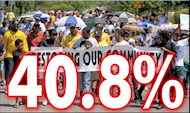
The Restoring our Community March was held on June 26th through the heart of the Wichita African American Community. The march united 34 Civic and Social organizations to focus increased attention and effort on addressing at-risk youth within our community. Fraternities, Sororities, Churches, Politicians, City Leaders, Social Groups, Community Activists, families of homicide victims, and concerned citizens all came together and marched, 4 miles, at 12 noon, in 98 degree weather, to call for an end top the violence. We marched right through our own community. And as we marched, we passed the bullhorn from Pastor to Pastor and we prayed, loudly and collectively for peace in our neighborhoods. We talked to the people we encountered along the route. We called out to the people still in their homes. And we challenged everyone, ourselves included, to do more...

Each of the organizations who participated in the march were asked to contribute a new initiative specifically designed to address the needs and issues surrounding our at-risk youth. We asked each organization to find new ways to reach out to youth beyond the pool of the best and brightest who many of our efforts often serve.

Yesterday, the front page of the Wichita Eagle featured a story on the drop in crime our city has recently experienced. And while the city-wide drop has been only 1.5%, the story says that the drop has been spurred by a more precipitous drop in the 'core of the city'. And while there are certainly any number of inter-related factors that contributed to this drop in crime and violence, I think it worthy of note that when we as a community come together we absolutely CAN make a difference!

Next Steps:
After the march, we also asked each of the organizations to commit to coming together again to talk about some specific ways that we can increase and strengthen our collaborative efforts. That meeting will take place on Saturday, September 4th, at 2:00pm in the McAdams Center (in McAdams Park). Immediately following the Black Arts Festival Parade, we  would like to have representatives from each of the participating organizations gather in the McAdams Rec Center for a brief meeting during which we will discuss each of the Organizations efforts to reach at-risk youth, and discuss some specific long-term projects that we could collaborate on that would really increase our collective efficacy.

So please, join us as we move into phase II of the 'Restoring our Community' Movement

The Restoring our Community Movement
Phase II: "Bridging the Gaps through strategic collaborations"

Saturday September 4th @ 2:00pm
(following the Black Arts Festival Parade)
McAdams Recreation Center

Participating Organizations
The Wichita Ministerial League, the National Pan-Hellenic Council, the Urban League of Kansas, the Peace and Social Justice Center, Sunflower Community Action, the African American Coalition, Real Men Inc, the Council of Elders, Alpha Kappa Alpha, Delta Sigma Theta, Sigma Gamma Rho, and Zeta Phi Beta Sororities, Alpha Phi Alpha, Kappa Alpha Psi, Iota Phi Theta, Phi Beta Sigma, and Omega Psi Phi Fraternities, The Wichita Chapter of the National Organization for Women, the Wichita Black Nurses Association, the Center for Heath and Wellness, the Universalist Unitarian Church, the Kansas African American Museum, 316 the Rescue Zone, "Do you want to Live or Die" , Woman to Woman, the Justice Keepers, the Advocacy Coalition of Kansas, Bigelow Bethea, Rice Services, the Boys and Girls Club, Real Men Real Heroes, the Kappa Leadership League, the Optimist Club, and the City of Wichita.  - AND YOU!!


If you would like to be a part of this effort, just plan to be in attendance on September 4th!!!

Read more...

wibiya widget


About This Blog

About This Blog

Jung/Myers Briggs

INTJ - "Mastermind". Introverted intellectual with a preference for finding certainty. A builder of systems and the applier of theoretical models. 2.1% of total population.
Free Jung Personality Test (similar to Myers-Briggs/MBTI)

  © Blogger templates Newspaper III by Ourblogtemplates.com 2008

Back to TOP